








Quick answer: Cats scratch because they need to — it keeps their claws healthy, marks territory and provides a full-body stretch. You cannot train it out of them, but you can redirect it completely by placing appealing scratchers in the right spots. A wall-mounted scratching board beside the furniture they target is often all it takes.
Written by Petifo's Expert Team · Updated July 2026 · Reading time: 6 min
Why Cats Scratch in the First Place
Scratching is not misbehaviour — it is one of the most deeply hardwired instincts a cat has. Punishing a cat for scratching is like telling it off for breathing. It will not stop, and it will damage the trust between you.
Cats scratch for three main reasons:
- Claw maintenance. Scratching strips away dead outer claw sheaths, revealing sharp, healthy claws underneath. Those papery husks you find near favourite scratching spots are a sign the process is working as nature intended.
- Territory marking. Cats have scent glands in their paw pads. Every scratch deposits pheromones invisible to us but unmistakable to other cats. This is why they tend to scratch near doorways, windows and high-traffic routes through the home.
- Stretching. Watch a cat scratch and you will see it extend its entire body — front legs overhead, back arched, claws dug in. Cats often do this immediately after waking because their muscles need a good pull after hours of stillness.
Your cat does not scratch the sofa to annoy you. It scratches the sofa because the sofa is in a good location, the fabric feels right, and no better alternative has been offered.
✅ Good to know: According to International Cat Care, scratching also serves as an emotional outlet. Cats scratch more frequently when they are excited, frustrated or slightly anxious — which is why it often happens when you come home or during play sessions.
Common Mistakes That Make Things Worse
Most owners genuinely try to fix furniture scratching, but a few well-meaning strategies tend to backfire badly.
Punishing the cat. Squirting water or shouting teaches a cat to scratch when you are not looking — not to stop. The stress it causes can actually increase scratching since scratching is a stress-relief behaviour.
Hiding the scratching post in a corner. A post tucked behind a bookshelf will be ignored. Cats scratch in socially significant spots — near where they sleep, beside entrances and along the routes they patrol. A scratcher needs to be where the cat already wants to scratch.
Choosing a wobbly or too-short post. If a post wobbles when a cat leans into it, the cat will never use it again. It needs to feel as stable as your sofa arm, and tall enough for a full overhead stretch.
Declawing. This is a surgical amputation of the last bone in each toe and is illegal in most European countries. It causes chronic pain and long-lasting behavioural problems. It is never a solution.
⚠️ Important: Claw caps (soft nail covers glued onto claws) are a temporary option some owners try, but they prevent natural claw shedding and can cause discomfort. The ASPCA and most feline welfare organisations recommend providing appropriate scratching surfaces rather than modifying the claws.
How to Choose the Right Scratcher
Not all scratching posts are created equal. The right one depends on how your cat prefers to scratch — and yes, cats have strong preferences.
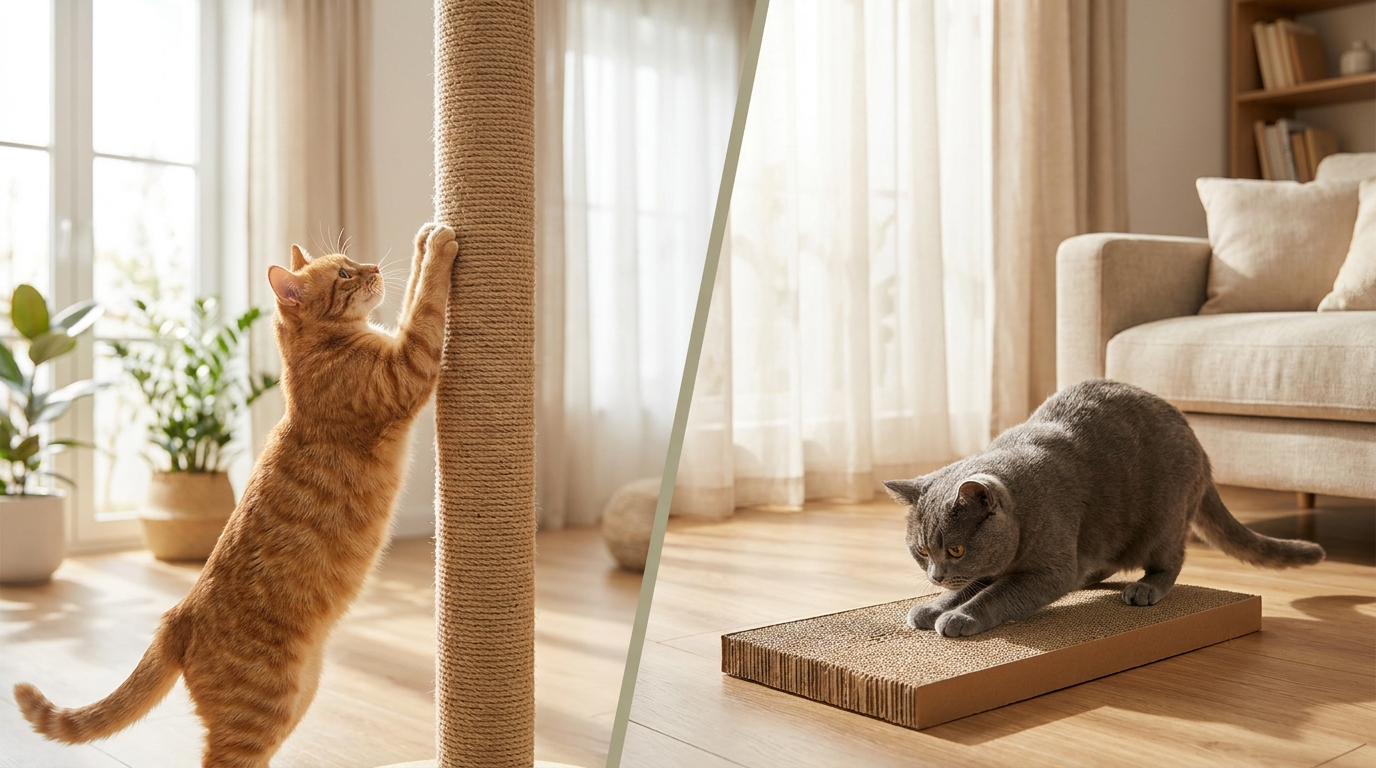
Vertical vs. horizontal. Most cats prefer vertical surfaces for the full overhead stretch, but some — particularly older or laid-back cats — prefer horizontal surfaces, pulling their claws along the ground. If your cat goes for sofa arms and door frames, it is a vertical scratcher. If it shreds the rug, it prefers horizontal.
Material matters. Sisal rope and sisal fabric are the gold standard — firm resistance, satisfying shredding texture. Corrugated cardboard is popular too, though it wears out faster. Carpet-covered posts can teach cats that carpet is an acceptable scratching surface, which you probably do not want.
Height and stability. The post should be at least as tall as your cat standing on its hind legs with paws extended — roughly 75 to 90 cm for an average adult. The base must be heavy enough that the post does not wobble at all. Cats reject an unstable post instantly.
A wall-mounted option like the PAWZ Wall-Mounted Scratching Board solves both the height and stability problem at once — it is fixed to the wall at whatever height suits your cat, it cannot tip over, and it saves floor space in smaller flats.
Placement: Where You Put It Is Everything
You could buy the finest scratching post on the market and your cat will ignore it if you put it in the wrong spot. Placement is more important than the product itself.
Start by identifying the surfaces your cat currently scratches, then place the new scratcher directly beside those spots. If your cat shreds the left arm of the sofa, mount a board on the wall right next to it.
Other high-priority locations:
- Near sleeping areas. Cats almost always scratch when they wake up, so having a scratcher within a few steps of their favourite napping spot is highly effective.
- Near entrances and windows. These are territory boundaries. Cats feel the strongest urge to mark here.
- In the main living area. Cats are social animals and want to mark the communal space. A scratcher hidden in a back room will not satisfy this drive.
Once the cat is regularly using the new scratcher, you can gradually move it — a few centimetres per day — to a more convenient location if needed. But do this slowly. If you shift it two metres overnight, the cat may revert to the furniture.
💡 Tip: If you have a multi-cat household, provide at least one scratching surface per cat plus one extra. Cats will not always share scratching spots, and conflict over resources can lead to stress-related scratching in unwanted places.
Redirection Techniques That Actually Work
Getting your cat to switch from the sofa to a scratcher is not about force — it is about making the scratcher more appealing than the furniture.
Use catnip or silver vine. Rub dried catnip or silver vine powder into the sisal surface. About 60 to 70 per cent of cats respond to catnip, and silver vine affects an even higher percentage. This draws the cat to investigate and usually triggers scratching.
Play near the scratcher. Dangle a feather wand around the base and sides of the post. When the cat lunges, its claws make contact with the surface — and the sensation often kicks off natural scratching behaviour. Reward that with a treat.
Make furniture temporarily less attractive. Cover targeted surfaces with double-sided sticky tape, aluminium foil or a tightly tucked throw during the transition period. These are bridges, not permanent fixes — remove them once the new habit is established.
Never force a cat's paws onto a scratcher. Grabbing its paws and dragging them down the post creates a negative association. Let the cat discover it on its own terms.
Our Pick: PAWZ Wall-Mounted Scratching Board
If your cat targets vertical surfaces like sofa arms or door frames, this wall-mounted design is ideal. It fixes to the wall at any height, takes up zero floor space and gives your cat the full stretch it craves — with no wobble, ever.

Petifo's PAWZ Wall-Mounted Scratching Board
A sleek, wall-mounted sisal scratching board that saves floor space and lets your cat stretch to full height — right where they actually want to scratch.
✨ Mounts beside furniture to redirect scratching exactly where it's needed
View product →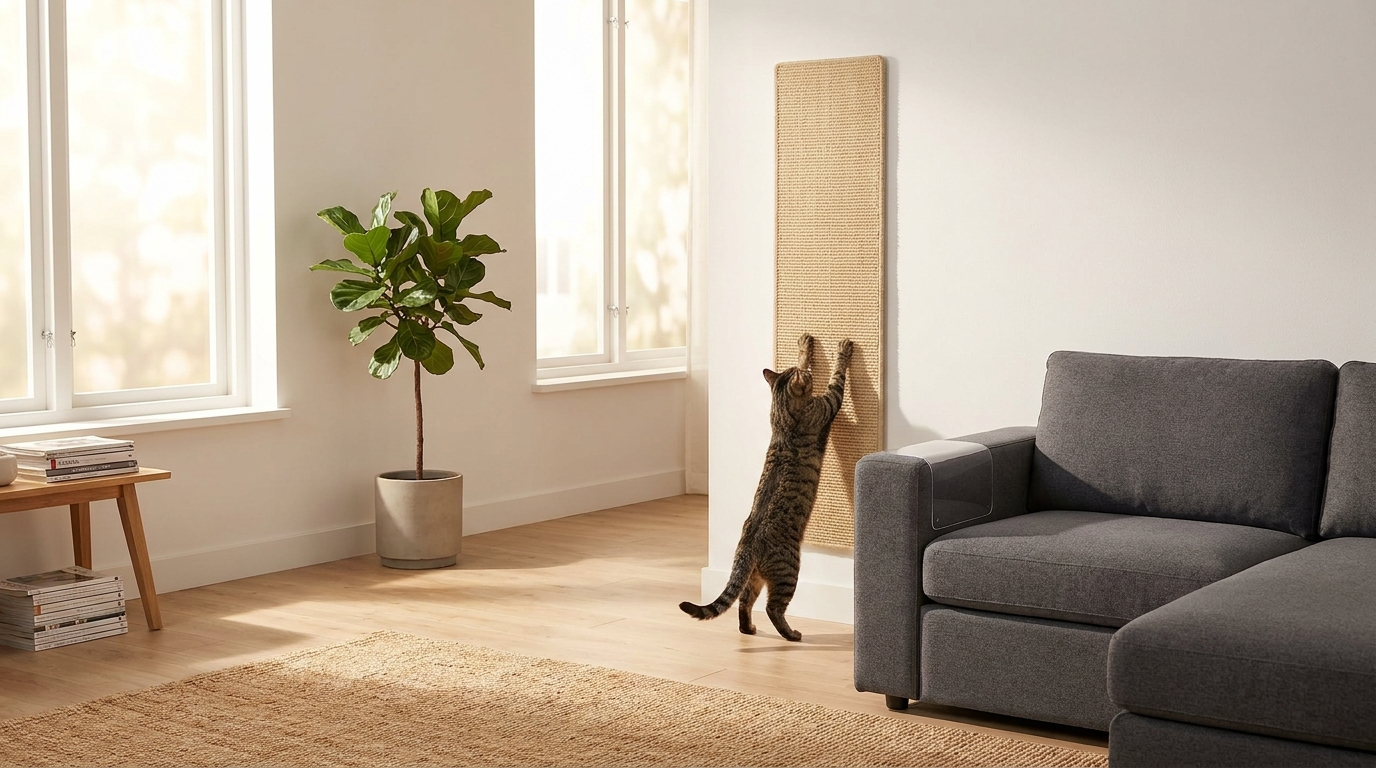
Other Scratching Options Worth Considering
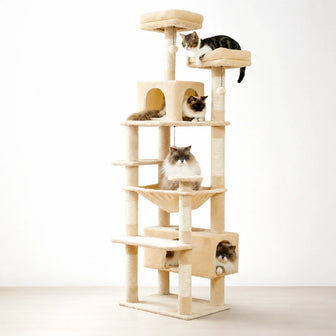
The Lunatto Scratching Barrel combines a multi-level hideout with scratching surfaces on the exterior — ideal for cats who like to scratch, climb and nap in one spot, and great in multi-cat households where the different levels reduce competition.
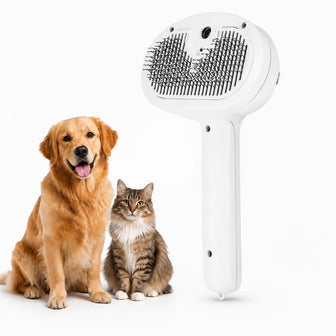
For scratching, climbing and grooming in a single piece of furniture, the PAWZ Cat Tree with Grooming Arch is worth a look. Sisal-wrapped posts, platforms for vertical territory and a built-in grooming arch make it a solid all-rounder.
Browse the full range in our Cat Trees & Scratching Posts collection.
Frequently Asked Questions
1. Why does my cat scratch the furniture even though it has a scratching post?
Usually placement. If the post is in a quiet corner but the furniture is in the main living area, the cat will choose the furniture. Move the post right beside the targeted piece of furniture and most cats switch within days.
2. What material do cats prefer to scratch?
Most cats prefer sisal rope or sisal fabric for the firm, satisfying shredding texture. Corrugated cardboard is another popular choice, though it wears out faster. Avoid carpet-covered posts — they can teach cats that carpet is fair game throughout the house.
3. How many scratching posts does a cat need?
Two to three in different key locations for a single cat. In multi-cat homes, one per cat plus one extra. Cats are territorial about scratching spots, so having enough prevents stress and furniture damage.
4. Can I use double-sided tape to stop my cat scratching the sofa?
Yes, as a temporary measure. Most cats dislike the sticky feeling on their paws. However, tape alone does not solve the problem — provide an attractive scratcher right next to the furniture at the same time. Remove the tape once the new habit is established.
5. Do kittens need a scratching post?
Absolutely. Kittens start scratching from around five weeks of age. Providing a scratcher early helps them develop the habit of using it instead of furniture. A smaller post or a horizontal cardboard scratcher is ideal for kittens, as they may not be able to reach a full-height vertical post yet.
6. Is it normal for cats to scratch more at certain times?
Yes. Cats tend to scratch most just after waking up, during periods of excitement (such as when you come home), and when they feel slightly stressed or frustrated. You may also notice increased scratching if there is a new cat in the neighbourhood — your cat is reinforcing its territorial markers.
7. Should I trim my cat's claws to reduce scratching damage?
Trimming reduces sharpness and limits damage, but it does not stop the scratching behaviour itself — cats still need to scratch for stretching and territory marking. Trim every two to three weeks if your cat tolerates it, but always provide proper scratching surfaces alongside.
Click the image below to learn more about Lunatto Scratching Barrel.

Sources: Cats Protection, International Cat Care, ASPCA, Blue Cross.