








Quick answer: Vertical space increases usable territory and gives cats choice: climb, observe, hide or rest. Build a stable route with several levels, secure fixings and at least two ways away from busy or contested spots.
Written by Petifo's Expert Team · Updated August 2026 · Reading time: 5 min
Explore this guide
- Think in routes rather than isolated shelves
- Choose between a freestanding tree and a wall system
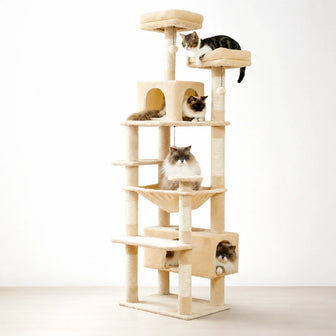
- Add both lookout points and hiding places
- Inspect stability as part of routine care
- Recommended Petifo products
- Frequently asked questions
Choose your next step
1 · Assess
Check your pet’s measurements, habits and current routine before changing equipment.
2 · Compare
Use the guide’s checkpoints to compare only the features that matter in your home.
3 · Introduce
Make one calm change at a time, observe your pet and adjust the routine as needed.
Plan safe cat vertical space with stable trees, wall routes, resting levels and easy access for different ages. This guide focuses on practical observation, gradual introductions and easy-to-maintain routines, so you can adapt each step to the individual animal rather than follow a rigid formula.
Think in routes rather than isolated shelves
A high perch is useful only if the cat can reach and leave it confidently. Plan a sequence of manageable jumps from the floor to a resting level, with no leap onto a slippery or narrow landing. In multi-cat homes, avoid dead ends where one cat can block another. Connect levels near a window or social room so height feels relevant to daily life.

Choose between a freestanding tree and a wall system
A cat tree offers scratching, climbing and resting in one movable structure. A wall route saves floor space and can extend across a room, but every component must be fixed to suitable wall structure with the correct hardware. Renters may prefer a stable freestanding model. Large or energetic cats need wider platforms and stronger anchoring than a small kitten.
💡 Practical tip: Create a continuous climb and exit route. Match platform size to the cat.
Add both lookout points and hiding places
Some cats want an open platform; others settle only when partially enclosed. A woven cave, hammock and high shelf create different kinds of choice. Place the most enclosed rest away from household traffic and avoid disturbing a hiding cat. Add a familiar blanket where safe, but keep loose fabric away from routes where paws could catch.

Inspect stability as part of routine care
Test for wobble, loose screws, frayed ropes, splintered wood and stretched fabric. Vacuum resting areas and follow cleaning instructions. Wall fixings can loosen with repeated jumping, so check them regularly. Kittens, older cats and cats with mobility limitations may need lower spacing, wider landings or a step stool to keep the route accessible.
✓ Good to know: Use suitable wall fixings. Offer both open and enclosed rest.
Introduce the change without losing trust
A reliable routine is built through small, observable steps. Begin in the easiest version of the situation, when your pet is rested and the room is quiet. Keep the first attempt short, then repeat it at roughly the same time before increasing difficulty. If the animal can approach, investigate and leave freely, you gain much clearer information than when equipment is placed on them or food is used to push through worry.
Change one variable at a time. That might mean adjusting height before angle, duration before speed, fit before distance, or location before adding another pet. Hold everything else steady for several sessions and note what you see: posture, breathing, pace, appetite, willingness to return and recovery afterwards. A simple record prevents a single unusually good or difficult day from driving the next decision.
Progress is not a straight line. Tiredness, weather, household noise and health can all affect a familiar routine. If your pet hesitates, return to the last comfortable step rather than adding pressure. Stop immediately for pain, panic, breathing difficulty, loss of balance or any sudden physical change. Equipment can support care, but it should never be used to mask a problem that needs veterinary assessment.
A simple seven-day setup plan
- Day 1: inspect the equipment, read the care instructions and let your pet observe it without interaction.
- Days 2–3: reward calm investigation and practise one simple step in a short session.
- Days 4–5: add one practical step: match platform size to the cat, then finish before attention drops.
- Day 6: use the setup in its real location while closely supervising posture and behaviour.
- Day 7: review cleaning, fit and safety, and decide whether to repeat, progress or step back.
Your quick decision checklist
Browse Petifo's cat vertical space collection for equipment that matches the routine described above.
Recommended Petifo products
The products below are selected because their verified specifications support the use cases in this guide. Always confirm dimensions, compatibility and care instructions on the product page.


Frequently asked questions about cat vertical space
1. Why do cats like high places?
Height can provide a broad view, more usable territory and distance from household activity.
2. How high should cat shelves be?
There is no single height. Build reachable steps based on the cat's age, confidence and mobility.
3. Are wall-mounted cat shelves safe?
They can be when fixed to suitable structure with appropriate hardware and checked regularly.
4. Does every cat need a cave?
Not every cat will use one, but access to a private hiding option is an important choice.
5. How many routes should a multi-cat setup have?
Aim for alternative paths and exits so one cat cannot trap or block another at a valued perch.
6. Can older cats use vertical space?
Yes, with lower jumps, wider platforms, non-slip surfaces and easier access.
Source: Cats Protection hiding and height guidance. General educational guidance only; contact your vet for individual health or behaviour concerns.