


Quick answer: Choose a trailer by your dog's body dimensions, weight, mobility and the routes you actually ride. Train stationary first, secure the harness tether and build from walking the bike to short, smooth rides.
Written by Petifo's Expert Team · Updated August 2026 · Reading time: 6 min
Explore this guide
- Choose the mode before the colour
- Measure the dog and the cabin
- Train in four calm stages
- Ride defensively and inspect every time
- Recommended Petifo products
- Frequently asked questions
Choose your next step
1 · Assess
Check your pet’s measurements, habits and current routine before changing equipment.
2 · Compare
Use the guide’s checkpoints to compare only the features that matter in your home.
3 · Introduce
Make one calm change at a time, observe your pet and adjust the routine as needed.
Compare dog bike trailers by cabin size, wheel type and conversion modes, then introduce cycling in safe stages. This guide focuses on practical observation, gradual introductions and easy-to-maintain routines, so you can adapt each step to the individual animal rather than follow a rigid formula.
Choose the mode before the colour
A trailer-pram suits households that alternate cycling and walking, while a compact multifunction model may add tent or cargo use. A spacious dedicated trailer prioritises cabin room and ride comfort. Compare functions you will genuinely use, because conversion hardware affects storage and handling. Check bicycle wheel compatibility, hitch instructions and local cycling rules before purchase.

Measure the dog and the cabin
Weight limits matter, but body length, seated height and turning space decide comfort. Measure from chest to rear and floor to top of head in a natural sit, then compare with internal dimensions. The dog should not remain hunched. Larger wheels and a broad stance can improve stability on rougher surfaces, though no trailer makes unsuitable terrain safe.
💡 Practical tip: Confirm hitch and bicycle compatibility. Measure dog and internal cabin.
Train in four calm stages
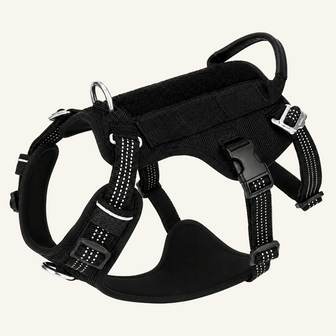
First reward exploration while the trailer is parked and secured. Next close the cabin briefly, then walk the bicycle by hand, and only then ride at low speed on a quiet flat route. Keep the dog attached by an internal tether clipped to a harness, not a collar. Watch for panting, scrambling, repeated turning or refusal to enter at the next session.

Ride defensively and inspect every time
Use the safety flag and reflectors, slow well before corners and avoid kerbs, steep slopes, traffic and hot surfaces. Brake smoothly and never leave the occupied trailer unattended. Before each ride check tyre pressure, wheel attachment, hitch, frame locks, zips and tether. Bring water and plan walking breaks so the trailer expands the dog's day rather than becoming prolonged confinement.
✓ Good to know: Train parked before moving. Clip the tether to a harness.
Introduce the change without losing trust
A reliable routine is built through small, observable steps. Begin in the easiest version of the situation, when your pet is rested and the room is quiet. Keep the first attempt short, then repeat it at roughly the same time before increasing difficulty. If the animal can approach, investigate and leave freely, you gain much clearer information than when equipment is placed on them or food is used to push through worry.
Change one variable at a time. That might mean adjusting height before angle, duration before speed, fit before distance, or location before adding another pet. Hold everything else steady for several sessions and note what you see: posture, breathing, pace, appetite, willingness to return and recovery afterwards. A simple record prevents a single unusually good or difficult day from driving the next decision.
Progress is not a straight line. Tiredness, weather, household noise and health can all affect a familiar routine. If your pet hesitates, return to the last comfortable step rather than adding pressure. Stop immediately for pain, panic, breathing difficulty, loss of balance or any sudden physical change. Equipment can support care, but it should never be used to mask a problem that needs veterinary assessment.
A simple seven-day setup plan
- Day 1: inspect the equipment, read the care instructions and let your pet observe it without interaction.
- Days 2–3: reward calm investigation and practise one simple step in a short session.
- Days 4–5: add one practical step: measure dog and internal cabin, then finish before attention drops.
- Day 6: use the setup in its real location while closely supervising posture and behaviour.
- Day 7: review cleaning, fit and safety, and decide whether to repeat, progress or step back.
What to record after the first week
Write down three short observations after each session: what your pet chose to do, how the equipment behaved and how quickly normal behaviour returned. Check whether the routine remained easy in real use, whether cleaning and storage fit the household routine, and whether another animal changed the response. Photos or short videos can help you compare posture over time and give a vet, groomer or qualified behaviour professional more useful context if you need advice.
A successful setup should become less dramatic with repetition. Your pet approaches without avoidance, the equipment stays secure, and you can maintain it consistently. If the routine becomes harder, do not assume stubbornness. Recheck fit, location, noise, wear and health before continuing.
Your quick decision checklist
Browse Petifo's dog bike trailer collection for equipment that matches the routine described above.
Recommended Petifo products
The products below are selected because their verified specifications support the use cases in this guide. Always confirm dimensions, compatibility and care instructions on the product page.


Frequently asked questions about dog bike trailer
1. Which dogs benefit from a bike trailer?
Small, older, recovering or lower-endurance dogs may benefit, subject to veterinary advice and product limits.
2. How large should the cabin be?
The dog should sit naturally, turn and lie down within the stated weight and body-size limits.
3. Can I clip the tether to a collar?
No. Use a well-fitted harness to avoid force on the neck.
4. How fast should I ride?
Begin very slowly and remain conservative, especially around corners, slopes and uneven surfaces.
5. Are pneumatic wheels better?
They can soften some roughness, but need pressure checks and do not make hazardous terrain suitable.
6. Can a puppy run beside a bicycle instead?
PDSA advises avoiding activities such as running and cycling until puppies are fully grown; a trailer still requires careful acclimatisation.
Source: PDSA puppy exercise safety. General educational guidance only; contact your vet for individual health or behaviour concerns.