


Written by Petifo's Expert Team · Updated July 2026 · Reading time: 6 min
Quick answer: A HEPA air purifier designed for pet owners captures up to 99.97% of airborne dander, fur particles, dust and odour-causing compounds. If you share your home with a cat, dog or other furry companion, running an air purifier in the rooms where your pet spends the most time can dramatically reduce allergens and leave your indoor air noticeably fresher.
Why Pet Homes Need an Air Purifier
Living with pets is one of life's genuine pleasures. The companionship, the unconditional affection, the evening walks and the sofa cuddles — it's hard to imagine home without them. But every pet owner also knows the less charming side: fur on every surface, a faint "wet dog" scent that guests notice before you do, and the invisible cloud of dander that floats through every room.
Pet dander — microscopic flakes of skin shed by cats, dogs, rabbits and other furry animals — is one of the most common indoor allergens in European households. According to the RSPCA, roughly 10–20% of the global population is allergic to cats or dogs, and even non-allergic owners can experience irritation when airborne particle levels climb too high indoors.
Unlike outdoor air, indoor air doesn't circulate freely. Dander, fine fur fibres, dust mites and volatile organic compounds from litter trays or pet beds accumulate throughout the day, especially during the winter months when windows stay closed. An ordinary vacuum cleaner handles what's on the floor, but it does very little for what's already floating in the air you breathe.
That's where an air purifier for pet owners makes a measurable difference. By pulling room air through a series of specialised filters — typically a pre-filter for large hair and lint, a true HEPA filter for microscopic particles, and an activated-carbon layer for odours — a well-placed purifier can reduce airborne allergens by up to 99.97%.

How HEPA Filters Work for Pet Owners
HEPA stands for High-Efficiency Particulate Air. To earn this designation, a filter must capture at least 99.97% of particles as small as 0.3 microns. A single strand of human hair is roughly 70 microns wide, and pet dander particles typically range from 2.5 to 10 microns — well within a HEPA filter's reach.
The filter forces air through a dense mat of randomly arranged fibres. Particles are trapped via interception, impaction and diffusion — three complementary mechanisms that together make HEPA filtration extraordinarily effective against pet allergens.
For pet households, look for purifiers that pair a true HEPA filter with a pre-filter and an activated-carbon layer. The pre-filter catches visible fur and larger lint before it clogs the HEPA stage, extending the main filter's life. The activated carbon adsorbs gaseous molecules — the source of litter-box smell, "wet dog" odour and other organic scents that particle filters alone cannot address.
Tip: Not all filters labelled "HEPA-type" or "HEPA-style" meet the true HEPA standard. When comparing purifiers, check that the product specifies true HEPA or H13 HEPA filtration — anything less may miss the smallest dander particles.
What to Look for in an Air Purifier for Pet Owners
With dozens of purifiers on the market, narrowing down the right one for a pet home can feel overwhelming. These are the key features worth prioritising:
1. Filter type. A true HEPA filter is non-negotiable. The best pet-focused units add a pre-filter for fur and an activated-carbon stage for odours — a three-stage system that covers the full spectrum of pet-related air pollutants.
2. Room size coverage. Every purifier is rated for a maximum room size in square metres. Choose a unit rated for at least the room where your pet spends the most time. If in doubt, go one size up — a slightly oversized purifier on a lower fan speed is quieter and still highly effective.
3. Noise level. Pets — especially cats — can be sensitive to unfamiliar sounds. A purifier that operates below 30 dB on its lowest setting is barely audible and won't startle a nervous animal. Many modern units include a dedicated sleep or night mode for exactly this reason.
4. Smart features. Air-quality indicators, auto-speed adjustment and timer functions are convenient extras. An auto mode that ramps up when it detects a spike in airborne particles (say, after a vigorous grooming session) is genuinely useful in a pet home.
5. Filter replacement cost and availability. A purifier is only as good as its filter, and every filter has a finite lifespan. Before committing to a unit, check that replacement filters are easy to source and reasonably priced. For the Chuboor Air Purifier, you can find the Chuboor Replacement Air Purifier Filter right here at Petifo — making ongoing maintenance straightforward.
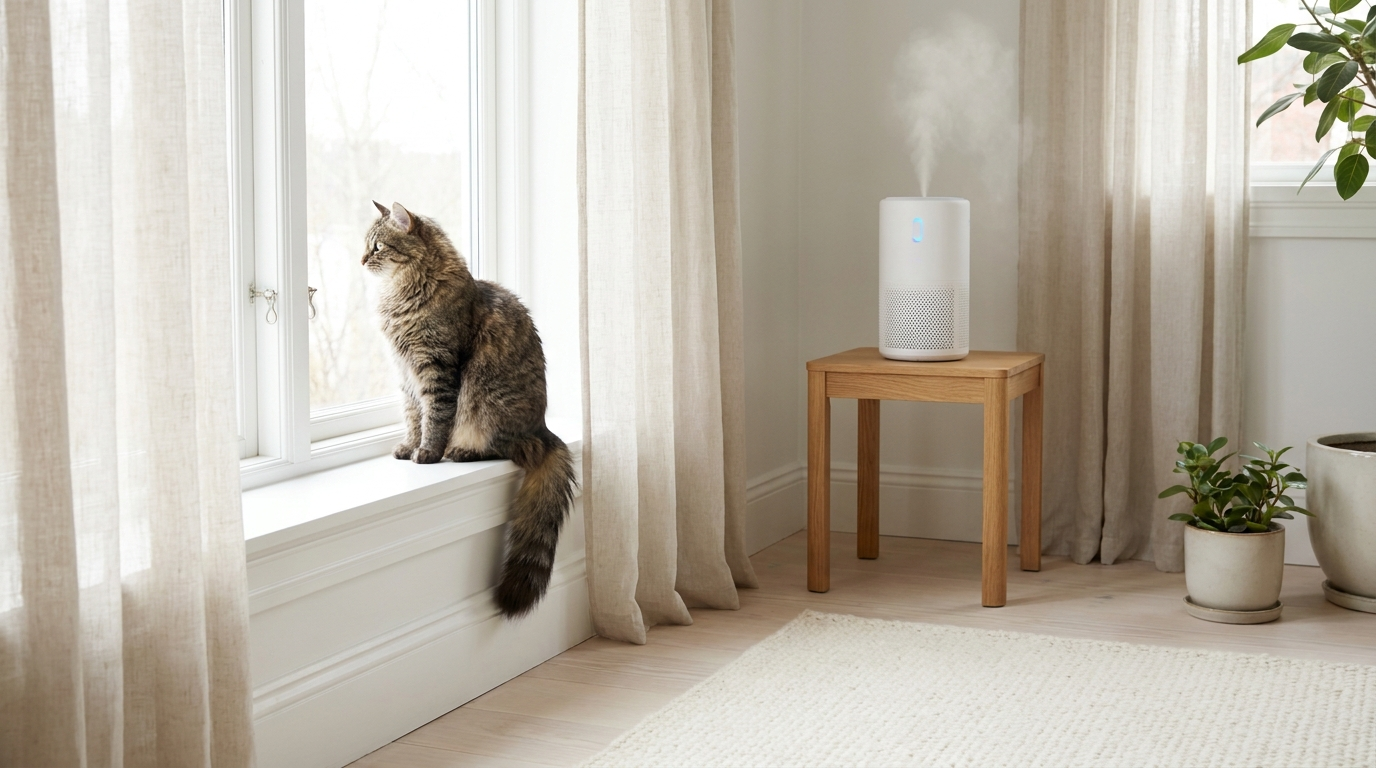
Placement Tips: Where to Put Your Pet Air Purifier
Even the best purifier underperforms if it's tucked behind a sofa or shoved in a corner. Position the unit in the room where your pet spends the most time — typically the living room or bedroom. Place it on a flat surface with at least 15–20 cm of clearance on all sides so air can flow freely. Avoid putting it directly against a wall or behind furniture.
If your pet sleeps in your bedroom, running the purifier on a sleep setting overnight can make a noticeable difference to morning allergy symptoms. The PDSA notes that prolonged dander exposure in enclosed sleeping spaces is a common trigger for sneezing, congestion and itchy eyes.
For multi-pet households or open-plan areas, consider running two smaller units rather than one large one — this creates overlapping zones of clean air.
Good to know: An air purifier complements your cleaning routine — it doesn't replace it. Regular vacuuming, washing pet bedding weekly and grooming your pet frequently will reduce the total allergen load, allowing your purifier to work more efficiently on whatever remains airborne.
Filter Replacement: How Often and Why It Matters
A clogged filter doesn't just stop working — it forces the motor to work harder, increases noise and can even push trapped particles back into the room. Sticking to a replacement schedule is essential.
Most manufacturers recommend changing the HEPA filter every 6–12 months. In a pet household, lean towards the shorter end. Homes with multiple pets or heavy shedders may need to replace filters even sooner.
The pre-filter is often washable — give it a rinse or vacuum every two to four weeks to keep airflow unrestricted. For the activated-carbon layer, replacement every 3–6 months is typical. If litter-box or "wet dog" smells linger despite the purifier running, the carbon is likely saturated.
Important: Never attempt to wash a true HEPA filter — water damages the fine fibre structure and destroys its particle-trapping ability. Only the pre-filter should be rinsed, and only if the manufacturer specifies it as washable.
Keeping spare filters on hand means you're never caught out. The Chuboor Replacement Filter is designed to slot directly into the Chuboor Air Purifier, making maintenance as simple as unscrewing the base, swapping the filter and twisting it back into place.
Our Pick: The Chuboor Air Purifier for Homes with Pets
After reviewing a range of pet-focused purifiers, we keep coming back to the Chuboor. It's compact, whisper-quiet on its lowest setting, and its three-stage filtration — pre-filter, true HEPA and activated carbon — is tailor-made for pet households. Whether you're dealing with seasonal shedding from a Labrador, year-round dander from an indoor cat, or the fragrance of a well-used litter tray, it handles the lot.

Petifo's Chuboor Air Purifier for Homes with Pets
A compact HEPA air purifier designed specifically for pet households — captures dander, fur, dust and odour.
Built for pet homes — tackles dander, fur and odour
View product →Frequently Asked Questions
1. Do air purifiers actually help with pet allergies?
Yes. A true HEPA purifier removes up to 99.97% of airborne particles down to 0.3 microns, including pet dander — the primary trigger for pet-related allergies. It won't eliminate allergens settled on furniture, but it significantly reduces airborne dander, leading to fewer sneezing fits, less congestion and calmer breathing.
2. Can an air purifier remove pet odour?
A HEPA filter alone won't remove odours because smells are caused by gaseous molecules, not particles. Purifiers that include an activated-carbon filter — like the Chuboor Air Purifier — adsorb these odour-causing compounds. The carbon layer tackles litter-box smells, wet-dog scent and general pet mustiness effectively.
3. How often should I replace the filter in a pet household?
In a home with one or two pets, plan on replacing the HEPA filter every 6–8 months. Multi-pet households or homes with heavy shedders should check the filter monthly and consider replacement every 4–6 months. Pre-filters should be rinsed or vacuumed every 2–4 weeks. The Chuboor Replacement Filter makes swapping quick and hassle-free.
4. Are air purifiers safe to use around cats and dogs?
HEPA and activated-carbon purifiers are perfectly safe for pets — they produce no ozone and release no chemicals. The only type to avoid is an ioniser or ozone generator, which can irritate the respiratory systems of both pets and humans. The Blue Cross recommends keeping pet living areas well-ventilated, and a quality HEPA purifier supports that goal without harmful side effects.
5. Should I run my air purifier 24/7?
Ideally, yes — or at least during the hours your pet is active indoors and overnight if your pet sleeps in the bedroom. Running the unit on a low or auto setting keeps particle levels consistently low. Most modern purifiers are efficient enough that 24/7 operation adds only a few pounds to your monthly electricity bill.
6. Where is the best place to put an air purifier in a pet home?
Place it in the room where your pet spends the most time, on a flat surface with at least 15–20 cm clearance on all sides. Avoid corners, spots behind furniture or areas blocked by curtains. If your pet sleeps in your bedroom, positioning the purifier on a bedside table or nearby shelf — set to sleep mode — can noticeably improve overnight air quality.
7. Will an air purifier help with cat litter dust?
Absolutely. The fine silica or clay dust that becomes airborne when a cat digs in the litter tray is well within a HEPA filter's capture range. Placing a purifier near the litter area helps contain dust clouds and stops them spreading to other rooms. The activated-carbon layer also neutralises ammonia and other litter-box odours.
Sources
- RSPCA — Royal Society for the Prevention of Cruelty to Animals
- PDSA — People's Dispensary for Sick Animals
- Blue Cross — Blue Cross for Pets
- PetMD — Pet Health and Care Information
- AKC — American Kennel Club