








Written by Petifo's Expert Team · Updated July 2026 · Reading time: 7 min
Quick answer: Every dog travelling in a car should be properly restrained — whether that means a raised car seat for smaller breeds, a sturdy crate for larger dogs, or a crash-tested harness. It keeps your dog safe in the event of sudden braking, prevents driver distraction, and in many European countries it is a legal requirement. A ramp is also worth considering for senior dogs or breeds prone to joint problems.
Why Restraining Your Dog in the Car Actually Matters
Most dog owners have done it — let their dog sit freely on the back seat, nose pressed against the window. It looks harmless, but an unrestrained dog in a moving vehicle is a genuine safety risk for everyone in the car.
At just 50 km/h, a 25 kg dog thrown forward in a collision exerts a force equivalent to roughly 750 kg — enough to seriously injure the dog and any passenger in the way. Even without an accident, a loose dog can block the pedals or distract the driver at a critical moment.
Then there is the legal side. In most EU countries — including Germany, Austria, and Italy — transporting a dog without adequate restraint can result in a fine. The UK Highway Code (Rule 57) requires that animals be suitably restrained so they cannot distract the driver. Enforcement varies, but insurance companies may refuse a claim if an unrestrained pet contributed to an accident.
⚠️ Important: An unrestrained dog in the boot or on the back seat can become a dangerous projectile in a collision. According to the RSPCA, dogs should always be secured using a purpose-built restraint — never left loose, even on short trips.
Car Seats, Crates or Harnesses — Which Restraint Is Right?
There is no single "best" option. The right choice depends on your dog's size, temperament, and how often you travel together. Here is a straightforward comparison of the three main types.
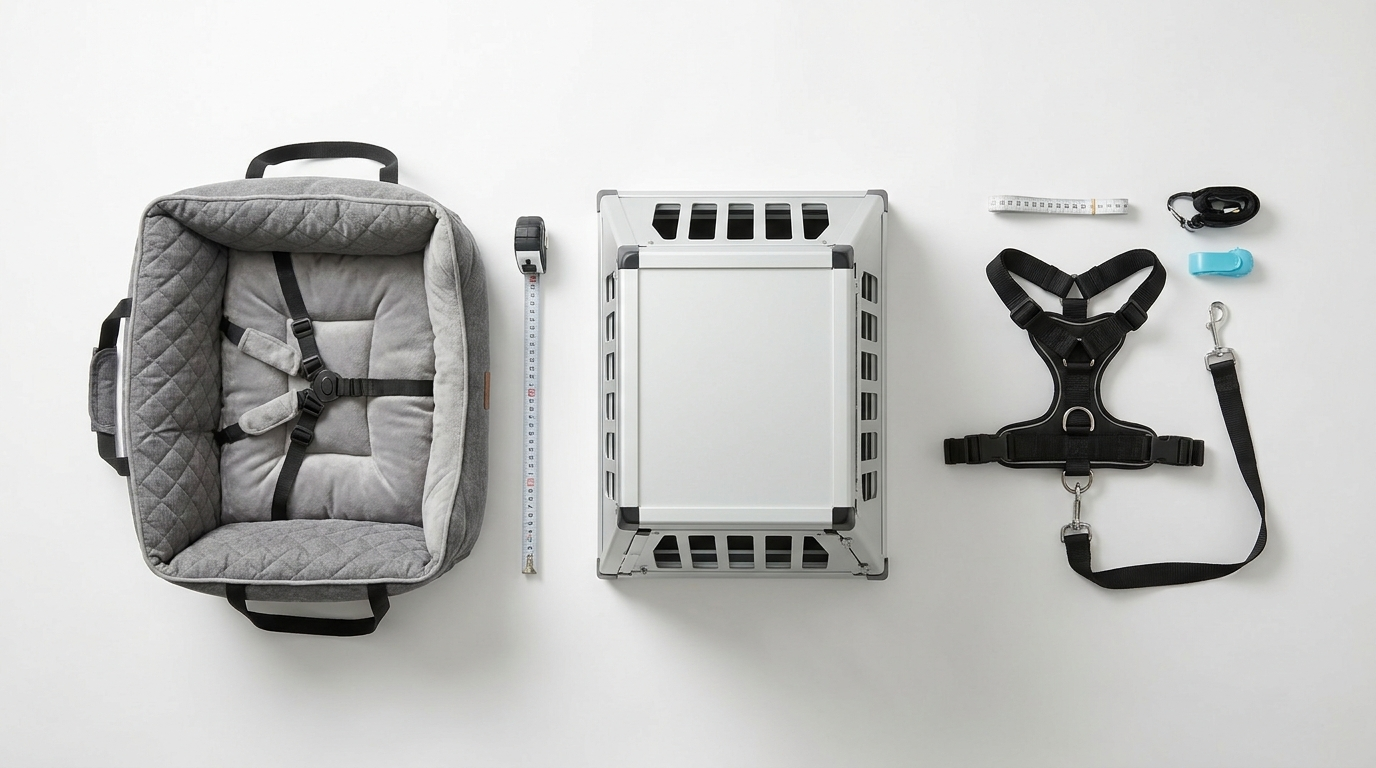
Car seats are ideal for small to medium dogs (up to roughly 12–15 kg). They raise your dog up so they can see out of the window — which many dogs find calming — while keeping them contained and secure. A good car seat attaches to the headrest or ISOFIX anchor and includes an internal tether that clips to the dog's harness. They are the most comfortable option for longer journeys and the easiest to install and remove.
Crates suit medium to large dogs and are the gold standard for boot (trunk) travel. A well-fitted aluminium crate gives your dog a secure, enclosed space and provides maximum protection in a crash. They are particularly useful for dogs that get anxious or over-excited in the car, since the enclosed environment has a natural calming effect. The trade-off is that they take up more space and are less convenient to move around.
Harness attachments clip your dog's harness directly to the seatbelt buckle. They are the cheapest and most portable option, but offer less crash protection than a seat or crate. If you go this route, choose one that has been independently crash-tested — the Centre for Pet Safety publishes a list of certified products.
Choosing by Dog Size
Size is the single biggest factor when picking a restraint. Getting it wrong means either a cramped, stressed dog or a restraint that cannot do its job in an emergency.
- Small breeds (under 8 kg) — Chihuahuas, Toy Poodles, Yorkshire Terriers. A raised car seat on the back seat is perfect. The elevation helps reduce motion sickness and lets your dog feel included rather than trapped.
- Medium breeds (8–25 kg) — Cocker Spaniels, Beagles, Border Collies. Either a larger car seat (if the weight limit allows) or a crate in the boot. Many medium dogs do well with a crash-tested harness too.
- Large breeds (25 kg+) — Labradors, German Shepherds, Golden Retrievers. A crate in the boot is the safest and most practical choice. Make sure the crate is large enough for your dog to stand, turn around and lie down comfortably.
💡 Tip: Measure your dog before buying any restraint. You need their length from nose to tail base, height from floor to top of head, and width across the shoulders. Always check the manufacturer's weight and dimension limits — a restraint that is too small will be uncomfortable, and one that is too large will not protect properly.
Why a Ramp Makes a Real Difference
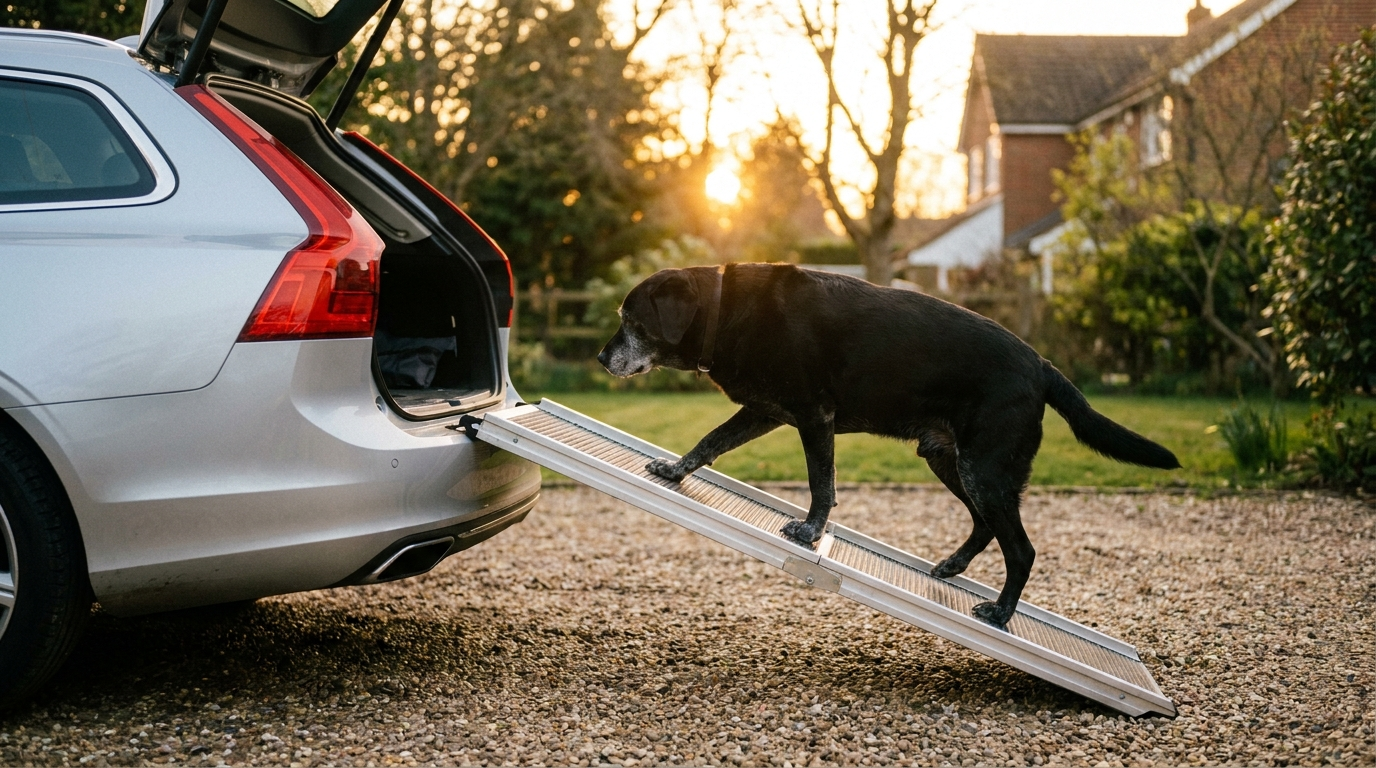
Jumping in and out of a car boot puts enormous strain on a dog's joints — particularly the hips, knees, and spine. For puppies whose growth plates have not yet closed, for senior dogs with arthritis, and for breeds predisposed to hip dysplasia (such as German Shepherds, Labradors, and Rottweilers), repeated jumping can accelerate joint damage over time.
A foldable ramp eliminates the impact entirely. Your dog walks up a gentle incline instead of leaping, which protects their joints and makes the process far less stressful — especially after surgery when your vet has advised against jumping.
Look for a ramp with a non-slip surface, side rails for confidence, and a weight rating that exceeds your dog's weight. Aluminium or reinforced plastic ramps are lighter to carry and will not rust if they get wet.

Petifo's Car Seat for Dogs and Cats
A raised, padded car seat that attaches securely to the headrest and includes an internal safety tether. Suitable for small to medium pets up to 12 kg. The elevated design gives your dog a clear view out of the window, reducing anxiety and motion sickness on longer drives.
✨ Washable cover, non-slip base, and fits any car seat
View product →Road Trip Tips: Keeping Your Dog Comfortable on Long Drives
Having the right restraint is only half the equation. Long journeys require a bit of planning to keep your dog relaxed and healthy.
Stop every two hours for a proper break — let your dog stretch, drink water, and go to the toilet. Never leave a dog in a parked car, even with the windows cracked; the PDSA warns that interior temperatures can rise to dangerous levels within minutes, even on overcast days.
Feed your dog a light meal two to three hours before departure. A full stomach combined with vehicle motion is a reliable recipe for nausea. Bring water and a collapsible bowl, but skip the treats until you have stopped.
If your dog is not used to the car, build up gradually — five-minute drives at first, then fifteen, then half an hour. Pair each trip with something positive so your dog associates the car with good things rather than just the vet.
✅ Good to know: Some dogs genuinely struggle with car sickness. If your dog drools excessively, vomits, or shakes during car journeys despite gradual desensitisation, speak to your vet. There are safe anti-nausea medications that can make a significant difference.
Complete Your Dog's Travel Setup
Beyond the car seat, two other products are worth considering depending on your dog's size and needs.
For larger dogs that travel in the boot, a purpose-built crate keeps them secure and calm. Aluminium crates are lightweight, easy to clean, and provide excellent ventilation — far better than a plastic carrier or a makeshift barrier.
And for any dog that needs help getting in and out of the vehicle — whether due to age, size, or a recent operation — a foldable ramp takes the strain off their joints and yours.
You can browse our full range of car travel gear in the Dog Car Seats & Travel collection.
Frequently Asked Questions
1. Is it a legal requirement to restrain my dog in the car?
In the UK, Rule 57 of the Highway Code states that animals must be suitably restrained. While there is no specific "dog seatbelt law," failing to secure your pet can result in a careless driving charge. Across the EU, most countries have similar regulations, and fines can range from €35 to over €500 depending on the country.
2. Can I put my dog on the front seat?
It is technically possible, but not recommended. Front-seat airbags can seriously injure or kill a dog if they deploy. If you must use the front seat — for example, in a two-seater van — deactivate the passenger airbag and use a properly secured car seat or harness.
3. How do I get my dog used to a car seat or crate?
Start by placing the seat or crate in your home and letting your dog explore it with treats and praise. Once they are comfortable climbing in voluntarily, move it to the car for short, positive trips. Most dogs adapt within a week or two if you take it gradually and keep the experience rewarding.
4. What size car crate do I need?
Your dog should be able to stand at full height without touching the top, turn around in a full circle, and lie down with their legs extended. Measure your dog and add 5–10 cm to each dimension. A crate that is too small causes stress; one that is too large offers less protection in a sudden stop.
5. Do dogs get car sick, and what can I do about it?
Yes, car sickness is common — especially in puppies whose inner ear structures are still developing. Signs include drooling, yawning, whining, and vomiting. Withholding food for two to three hours before travel, keeping the car cool and well-ventilated, and using a raised car seat (which provides a view of the horizon) can all help. Persistent cases should be discussed with your vet.
6. At what age does a dog need a ramp?
There is no fixed age — it depends on the breed, size, and joint health. Large breeds and breeds prone to hip dysplasia benefit from a ramp at any age to prevent cumulative joint stress. For most dogs, a ramp becomes especially valuable from around seven or eight years old, or following any orthopaedic surgery.
7. Can I use a regular pet carrier instead of a car crate?
A plastic pet carrier is better than nothing, but it is not designed to withstand the forces of a car crash. Carriers can crack or break open on impact, and they rarely secure firmly to the vehicle. A purpose-built car crate — particularly one made from aluminium — is significantly safer and more durable.
Click the image below to learn more about the Foldable Dog Ramp.

Click the image below to learn more about the Aluminium Dog Crate for the Car.

Sources: RSPCA, PDSA, Blue Cross, The Kennel Club, PetMD, AKC.